
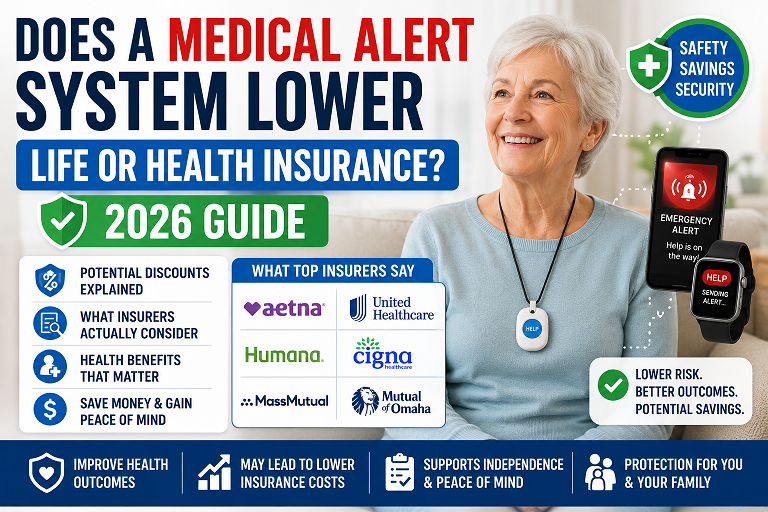
Does a Medical Alert System Lower Life or Health Insurance? 2026 Guide
A medical alert system does not directly lower life insurance or standard health insurance premiums in 2026. However, it can significantly reduce what you pay for the device itself through several overlapping programs. Medicare Advantage plans (Part C) may cover the full cost of a medical alert system as a supplemental benefit — coverage varies by plan. Long-term care insurance may reimburse the cost under assistive device provisions. Veterans can receive free basic devices through the VA. AARP members get discounts directly from multiple providers. And federal employees covered by FEHB plans (including GEHA) have medical alert system discounts available as a membership benefit. The right question isn’t “does a medical alert system lower my insurance?” — it’s “does my insurance lower my medical alert system cost?” That answer is often yes.
Does a medical alert system lower life or health insurance? This is one of the most searched questions among seniors and their adult children researching personal emergency response systems in 2026 — and the answer is more nuanced than most guides acknowledge. The short version: a medical alert system does not reduce your premium directly in the way a home security system can reduce homeowners insurance. But insurance and assistance programs can dramatically reduce what you pay for the medical alert system itself, sometimes to zero.
This guide covers every insurance category and assistance program relevant to medical alert system costs in 2026 — from Original Medicare’s firm exclusion to the Medicare Advantage plans that do cover devices, to VA benefits, AARP discounts, and federal employee health programs. Whether you’re shopping for a system for yourself or a parent, knowing these paths before you purchase can save hundreds of dollars per year.
Does a Medical Alert System Lower Life Insurance?
No major life insurance carrier in 2026 offers a specific premium discount for owning a medical alert system. Life insurance underwriting is based on health status, age, lifestyle risk factors, and mortality tables — not the safety devices a policyholder owns. A medical alert device is a reactive safety tool, not a health modifier, and it does not change the actuarial risk profile that determines your premium.
There is one indirect path worth knowing: some life insurance carriers that offer wellness-linked discount programs — most notably John Hancock’s Vitality program — reward active health behaviors like exercise, healthy eating, and preventive health screenings with premium discounts. If a senior uses a medical alert smartwatch (like Medical Guardian’s MGMove) that also tracks steps, heart rate, and activity, the activity data might contribute to wellness program points. But this is indirect, varies by carrier, and the discount comes from the wellness behaviors the smartwatch tracks — not from the medical alert function itself.
The Right Question to Ask Your Life Insurer
Rather than asking “does my medical alert system lower my life insurance?”, ask your life insurance agent: “Do you have a wellness or vitality program that rewards health behaviors, and would activity data from a wearable device count toward that program?” The answer varies by carrier. If yes, a medical alert smartwatch that also tracks activity could indirectly contribute — but confirm the program specifics before assuming any discount applies.
Does a Medical Alert System Lower Health Insurance?
Standard health insurance — whether employer-sponsored or purchased through the individual marketplace — does not offer premium reductions specifically for owning a medical alert system. Health insurance premiums are set based on age, location, plan tier, and in some cases tobacco use — not on the devices you own at home.
However, some health plans offer medical alert systems as a covered benefit or wellness program perk rather than a premium discount. The distinction matters: instead of paying less in premiums, you may pay nothing (or less) for the device and monitoring itself. This is particularly true for certain Medicare Advantage plans and federal employee health plans (FEHB), which are detailed below.
Original Medicare: What It Covers (and Doesn’t)
Original Medicare does not cover medical alert systems or personal emergency response devices in 2026. Recent analyses confirm that Original Medicare continues to exclude these systems from coverage, with no policy changes anticipated through at least 2026.
Medical alert systems are not classified as durable medical equipment (DME) under Medicare’s coverage rules. DME — the category that includes walkers, wheelchairs, hospital beds, and oxygen equipment — requires a physician’s prescription and must serve a medical purpose. A medical alert device is considered a preventive safety tool rather than a treatment device, which is why it falls outside Medicare’s DME coverage definition.
Medicare Advantage Plans That Cover Medical Alert Systems
Some Medicare Advantage plans include medical alert systems as a supplemental benefit — meaning the plan covers the device and monitoring cost as an added service beyond standard Medicare benefits. Coverage, eligible devices, monthly monitoring allowances, and qualifying conditions vary significantly between plans and geographic areas.
A Medicare Advantage plan in one state may provide a full medical alert system at no cost, while an identical-sounding plan in another state may not list this benefit at all. Some plans provide a specific pre-approved device; others offer a monthly allowance (typically $20–$50/month) that can be applied toward the device of your choice — which may or may not cover the full cost.
- Log into your Medicare Advantage plan’s member portal
- Look for “Supplemental Benefits” or “Extra Benefits” in the plan summary
- Search specifically for “personal emergency response system,” “medical alert,” or “PERS”
- Call the plan’s member services line and ask directly — plans update benefits annually and the agent can confirm current eligibility
- Use the Medicare Plan Compare tool at medicare.gov to compare plans in your area that include this benefit when selecting coverage
Long-Term Care Insurance Coverage
Long-term care insurance is private insurance designed to help with the costs of aging or permanent disability — nursing home care, home health aides, assisted living, and related services. Some policies include medical alert systems as a covered benefit under “home modification,” “assistive device,” or “personal emergency response” provisions. Coverage is not universal and depends entirely on your specific policy’s language.
Policies issued in the 1990s and early 2000s often have more restrictive benefit definitions than newer policies. If your long-term care policy was issued before 2010, it may not explicitly mention medical alert systems — but may cover them under a broader “home safety device” category that predates the current product terminology.
VA Benefits for Veterans
Eligible veterans can access free medical alert devices through the VA healthcare system. To qualify, veterans generally need to be enrolled in VA healthcare and meet specific medical criteria — typically a documented high fall risk, living alone, or a medical condition that increases emergency response needs. The evaluation is conducted through the VA’s home health assessment process.
VA-provided devices include basic wearable pendants with emergency call buttons and monitoring features — comparable to entry-level commercial products. Veterans who want advanced features like GPS tracking, caregiver apps, smartwatch form factors, or fall detection may need to supplement with a commercial provider, though some TRICARE for Life plans and VA health benefits may provide partial reimbursement for upgraded systems.
AARP and Other Member Discounts
Many medical alert system companies offer AARP member discounts. The American Association of Retired Persons has negotiated discounted rates with multiple providers, and the AARP annual membership fee ($16/year) is typically recouped quickly if any discount applies.
The specific companies offering AARP discounts and the discount amounts change periodically. As of 2026, the AARP website lists medical alert system discounts under its member benefits section. Before purchasing any medical alert system, call the provider directly and ask: “Do you offer an AARP member discount?” — even if it’s not prominently advertised on their website.
Federal Employee Health Plans (FEHB)
Federal employees, retirees, and their family members covered by certain FEHB plans have access to medical alert system discounts as member benefits. GEHA (Government Employees Health Association), one of the largest FEHB plan providers, explicitly lists medical alert system discounts as a 2026 member benefit alongside hearing aid discounts, gym memberships, and wellness programs.
FEHB plan members should log into their plan’s member portal and look under “Member Benefits,” “Wellness Rewards,” or “Member Discounts” for current medical alert offerings. These benefits change with each annual open season enrollment period.
6 Ways to Reduce Your Medical Alert System Cost Right Now
If none of the above insurance or benefit programs cover your specific situation, these are the most direct ways to reduce out-of-pocket medical alert system costs in 2026, from lowest cost first:
Check Medicare Advantage Supplemental Benefits First
If you’re on Medicare Advantage, this is the highest-value check. Log into your plan portal, search “personal emergency response system” or “medical alert,” and call member services if nothing appears. Some plans cover the full device and monitoring cost. Do this before purchasing anything.
If You’re a Veteran, Apply Through the VA First
Contact your VA healthcare provider and ask about personal emergency response system eligibility. A free VA-provided device covers the core function — press the button, get help — at zero cost. Add a commercial plan later if you need advanced features like GPS or fall detection.
Contact Your Local Area Agency on Aging
Find your local agency at eldercare.acl.gov. Many Area Agencies on Aging offer subsidized or loaned medical alert devices for low-income qualifying seniors. This is an underused resource that can eliminate the cost entirely for qualifying individuals.
Ask About AARP, AAA, and Employer Discounts Before You Purchase
Call the medical alert provider you’re considering and ask: “What membership or affiliation discounts do you offer?” before giving any payment information. AARP, AAA, employer wellness programs, and credit unions often have negotiated rates that aren’t displayed on the provider’s website.
Check Your Long-Term Care Insurance Policy Language
If you have long-term care insurance, call your carrier and ask specifically whether “personal emergency response systems” or “home safety assistive devices” are covered under any benefit provision. Ask for the determination in writing. Don’t accept a verbal “no” without a specific policy exclusion cited.
Choose No-Contract, Month-to-Month Providers
Avoid multi-year contracts (Life Alert requires a 3-year contract at higher rates). MobileHelp starts at $24.95/month with no contract. Bay Alarm Medical starts at $27.95/month with a 15-day risk-free trial. These are the most cost-effective entry points if you need to pay out of pocket.
Comparing Medical Alert Systems for Seniors?
Our full guide covers the best medical alert systems for seniors with smart home integration — including Bay Alarm Medical, Medical Guardian, MobileHelp, and ADT — with fall detection, Alexa and Google Home compatibility, and pricing compared.
Coverage and Discount Summary by Program
| Program | Covers Device? | Covers Monitoring? | Lowers Insurance Premium? | Action |
|---|---|---|---|---|
| Original Medicare (A&B) | ❌ No | ❌ No | ❌ No | Explore Medicare Advantage instead |
| Medicare Advantage (Part C) | ⚠️ Some plans | ⚠️ Some plans | ❌ No | Check your plan’s supplemental benefits section |
| Medicaid | ⚠️ Some states | ⚠️ Some states | ❌ No | Check your state’s PERS waiver program |
| Long-term care insurance | ⚠️ Some policies | ⚠️ Some policies | ❌ No | Call carrier — ask specifically about PERS coverage |
| VA benefits | ✅ Eligible veterans | ✅ Basic monitoring | ❌ No | Apply through VA healthcare enrollment |
| AARP membership | ⚠️ Discount only | ⚠️ Discount only | ❌ No | Ask provider about AARP rate before purchasing |
| FEHB / GEHA | ⚠️ Discount benefit | ⚠️ Discount benefit | ❌ No | Check plan member benefits portal |
| Life insurance | ❌ No | ❌ No | ❌ No direct discount | Ask about wellness programs (e.g., John Hancock Vitality) |
| Standard health insurance | ❌ Rarely | ❌ Rarely | ❌ No | Check employer wellness program benefits |
Conclusion: Does a Medical Alert System Lower Insurance?
A medical alert system does not lower life insurance or standard health insurance premiums in 2026 — no carrier in any category offers a premium reduction specifically for owning one. But the question many seniors and families are really asking is: “Can I get a medical alert system at lower cost through my insurance or benefits?” — and the answer to that question is frequently yes.
Medicare Advantage plans increasingly cover medical alert systems as supplemental benefits, sometimes at zero cost to the member. VA benefits provide free basic devices to eligible veterans. AARP and FEHB members have access to negotiated discounts. Long-term care insurance policies may cover the cost under assistive device provisions. And Area Agencies on Aging offer subsidized devices for qualifying low-income seniors.
Before paying full price for any medical alert system, spend 20 minutes checking the programs in this guide. For many seniors, the system that costs $30–$45/month at retail is available at no cost through an existing benefit — one they didn’t know to ask about. That’s the real answer to whether a medical alert system and insurance can work together.
Frequently Asked Questions
Does a medical alert system lower life insurance premiums?
No major life insurance carrier in 2026 offers a specific premium discount for owning a medical alert system. Life insurance premiums are based on health status, age, and mortality risk — not safety devices owned. The indirect exception: some wellness-linked life insurance programs (like John Hancock Vitality) reward health behaviors tracked by wearable devices, and a medical alert smartwatch that also tracks activity could potentially contribute to wellness program points. Confirm specifics with your carrier.
Does a medical alert system lower health insurance premiums?
Standard health insurance does not offer premium reductions for owning a medical alert system. However, some Medicare Advantage plans and federal employee health plans cover the cost of a medical alert system as a supplemental benefit — which effectively reduces your out-of-pocket cost without changing your premium. Check your specific plan’s supplemental benefits section before purchasing any device.
Does Medicare cover medical alert systems?
Original Medicare (Parts A and B) does not cover medical alert systems in 2026, and no policy changes are anticipated. Medical alert systems are not classified as durable medical equipment under Medicare’s coverage rules. Some Medicare Advantage plans (Part C) include medical alert systems as a supplemental benefit — coverage varies significantly by plan and location. Use the Medicare Plan Compare tool at medicare.gov to identify plans in your area that offer this benefit.
Does long-term care insurance cover medical alert systems?
Some long-term care insurance policies cover medical alert systems under home modification, assistive device, or personal emergency response provisions — but coverage is not universal. Call your carrier directly and ask specifically whether “personal emergency response systems” or “home safety assistive devices” are covered under any benefit provision in your policy. Ask for the determination in writing.
Do veterans get free medical alert systems?
Eligible veterans can receive free basic medical alert devices through the VA healthcare system. Veterans generally need to be enrolled in VA healthcare and meet specific medical criteria such as high fall risk or living alone. VA-provided devices include basic wearable pendants with emergency call buttons. Veterans wanting GPS tracking, fall detection, or caregiver apps may prefer commercial providers, though LifeStation and others offer specific veterans’ discounts.
Does AARP offer discounts on medical alert systems?
Yes — many medical alert system companies offer AARP member discounts. Call your chosen provider and ask about AARP rates before purchasing. AARP membership costs $16/year and can pay for itself quickly if even a partial discount applies. Visit AARP.org and search “medical alert systems” to see current partner discounts listed in their member benefits section.
What is the cheapest way to get a medical alert system in 2026?
The lowest-cost paths in order: (1) Check Medicare Advantage supplemental benefits — some plans cover it at no cost. (2) Apply through the VA if you’re an eligible veteran. (3) Contact your local Area Agency on Aging for subsidized devices. (4) Check AARP and employer wellness discounts before purchasing. (5) Choose MobileHelp at $24.95/month with no contract. (6) Use Bay Alarm Medical’s 15-day risk-free trial. Avoid multi-year contracts from providers like Life Alert.
Related Guides
- SeniorLiving.org — Are Medical Alert Systems Covered by Insurance in 2026? (April 2026)
- SeniorLiving.org — Medical Alert System Medicare Coverage in 2026 (April 2026)
- Medicare.org — Does Medicare Cover Medical Alert Systems? (June 2026)
- MedicareGuide.com — Does Medicare Cover Medical Alert Systems? (May 2026)
- The Senior List — Does Medicare Cover Life Alert in 2026?
- MedicareFAQ — Does Medicare Cover Life Alert? (March 2026)
- GEHA — Medical Alert System Member Benefit (2026)
- Eldercare Locator — Find Local Area Agency on Aging
- Medicare.gov — Plan Compare Tool