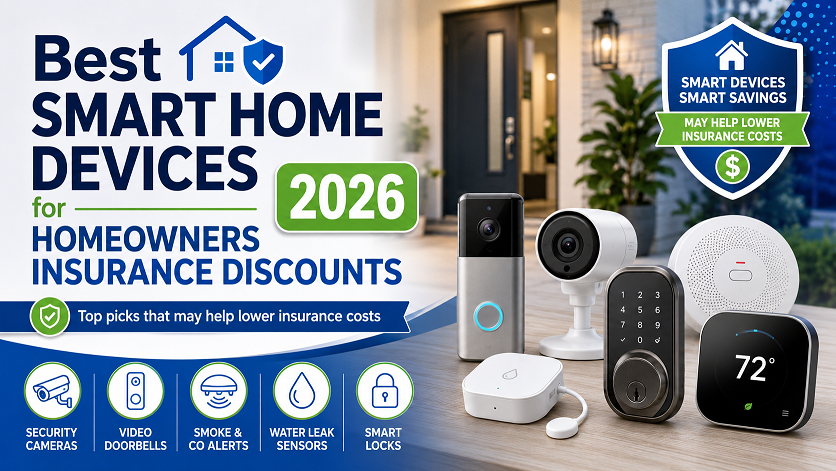
Best Smart Home Devices for Homeowners Insurance Discounts 2026
The highest-value combination for insurance discounts in 2026: a professionally monitored security system (10–20% discount) + smart smoke/CO detectors (up to 5%) + water leak sensors (1–5% additional). On a $2,300 national average policy, stacking all three can save $300–$460/year — often more than enough to cover monitoring fees. Not all discounts are additive and not all carriers offer all categories — always confirm with your agent. The most underrated device: water leak sensors, which target water damage claims that average $12,000 per incident and are increasingly rewarded by carriers.
Insurance companies set premiums based on risk. When you install devices that prevent damage or reduce the likelihood of a claim, your risk profile improves — and insurers increasingly translate that into direct premium savings. The key word is “increasingly”: smart home insurance discounts are expanding as claim data accumulates showing that homes with monitored systems and detection devices genuinely file fewer and smaller claims.
This guide covers every device category that meaningfully impacts homeowners insurance premiums in 2026 — what each one earns, which insurers honor it, and how to document and stack discounts for the maximum possible savings on your policy.
How Smart Home Insurance Discounts Actually Work
Before the device-by-device breakdown, the most important thing to understand: insurers don’t discount the device — they discount the risk reduction. A $30 water leak sensor doesn’t earn a discount because it’s smart. It earns a discount because it reduces the probability of a $12,000 water damage claim. The device is a proxy for risk management.
Two things determine whether a discount is available and how large it is:
- Device category and monitoring status. Professionally monitored systems earn larger discounts than self-monitored ones. Detection devices (smoke, CO, water) earn separate discounts from security systems. These can often be stacked.
- Your specific insurer and state. Discount availability and percentages vary significantly by carrier and state. A 15% security discount with State Farm in one state may be 8% in another. Carrier-specific partnerships (Nationwide + their smart home program, USAA + Resideo, American Family + Ring) can provide discounts beyond what’s available to the general public through standard discount programs.
The Documentation Rule
Most discounts require documentation — either a professional monitoring certificate (for security systems), proof of installation (receipts, photos), or enrollment in a carrier-specific program. Discounts are rarely applied automatically. You typically need to actively ask your agent, provide documentation, and in some cases re-submit documentation annually. This is the step most people miss, which means they have qualifying devices but never claim the discount.
Category 1: Monitored Security Systems (Biggest Discount)
The largest available category of smart home insurance discount. Professional monitoring — where a UL-listed central station dispatches police, fire, or medical services — is what most carriers require for discounts above 5%. Applies to Ring Alarm (with Protect Pro), SimpliSafe (with monitoring), Abode (with Connect+ or Pro plan), ADT, Vivint, and similar professionally monitored systems.
Best products in this category: Ring Alarm Pro with Protect Pro ($20/month), SimpliSafe with monitoring (from $22/month — with USAA members getting 50–60% off hardware), Abode with Connect+ ($20/month), ADT (from $45/month — higher cost but maximum insurer acceptance).
Category 2: Smart Smoke & CO Detectors
Smart smoke detectors earn fire alarm discounts at most major carriers — typically 5% or a flat dollar amount. The “smart” element (remote alerts, interconnected awareness, self-diagnostics) strengthens the discount case over traditional detectors, though even basic smoke detectors often qualify for this category.
Best products in this category: Nest Protect (Google) — integrates with Google Home, sends phone alerts, and performs self-testing; X-Sense FS31 for multi-room monitoring; First Alert ZCOMBO (Z-Wave compatible with Abode and other security hubs — when connected to a monitored hub, smoke triggers the monitoring center which can dispatch fire services, potentially qualifying for a higher security-tier discount). Prices range from $40 to $130/unit.
Category 3: Water Leak Sensors (Most Underrated)
Water damage is the most common homeowners insurance claim type — about 1 in 60 insured homes files a water damage or freezing claim each year, with average payouts over $12,000. This makes water leak sensors the device category with the clearest, most direct claim-reduction logic — and insurers are increasingly reflecting this in discount programs.
Best products:
- Resideo RCHW3610 (~$35) — Detects water AND excess humidity (mold risk indicator). Resideo has a direct partnership with USAA’s Connected Home program.
- Flo by Moen (~$200–$350) — Whole-home water flow monitoring; shuts off water supply automatically when a leak is detected. The highest-impact single device for water claim prevention.
- Phyn Plus (~$350) — Smart water assistant that monitors usage patterns and can auto-shut off; designed to prevent both leaks and pipe freezing.
- First Alert Water Leak Detector (~$30) — Compatible with USAA’s Connected Home program; simple placement under sinks, near water heaters, appliances.
- Abode Water Leak Sensor (~$35) — Integrates with Abode’s monitored security hub; may qualify for an additional 1–3% on top of the security system discount at some carriers.
Category 4: Smart Locks
Smart locks rarely earn a standalone homeowners insurance discount. Their value to insurers is indirect: as part of a broader security narrative, documented entry/exit logging, and deterrence. Most carriers don’t have a specific “smart lock discount” line item.
Where smart locks contribute most to insurance savings: when they’re part of a comprehensive security package that includes a monitored alarm, cameras, and sensors — the totality of the setup strengthens your case for the maximum available security discount. Some regional and specialty insurers have smart lock partnerships; if you’re with a regional carrier, ask specifically.
Best products for this purpose: Schlage Encode Plus, Yale Assure Lock 2, Level Lock+ — any smart lock that integrates into a broader security hub is more valuable for insurance purposes than a standalone lock.
Category 5: Smart Thermostats
Smart thermostats have indirect insurance relevance — particularly for frozen pipe prevention during winter absences — but most carriers don’t offer a specific “smart thermostat discount” line item. USAA’s Connected Home program includes Resideo thermostats (which combine temperature monitoring with leak detection), and a few carriers note temperature monitoring as part of their general smart home device criteria.
Best products: Google Nest Learning Thermostat, Ecobee SmartThermostat, Resideo (Honeywell) T9 — if you’re a USAA member, check whether the Resideo model in your Connected Home program qualifies.
How to Stack Discounts for Maximum Savings
The real opportunity isn’t any single device — it’s combining devices across categories that your insurer counts separately. Here’s what a fully stacked setup looks like on a $2,300 policy:
Total: $414/year in savings — covers Ring Protect Pro ($200/year) with $214 to spare. At a 15% security discount + 5% fire + 3% water: $530/year savings. At maximum Allstate (20% security + stacked): potentially $460–$600+/year. Actual results depend on your carrier, state, policy size, and whether your carrier allows stacking. Always confirm stacking eligibility with your agent before installing devices specifically for this purpose.
The Best $35 You Can Spend for Insurance Purposes
If you have a professionally monitored security system and want to maximize additional stackable discounts with the lowest possible upfront cost: put a Resideo or First Alert water leak sensor under your kitchen sink, bathroom sink, and water heater (three sensors at ~$30–35 each, or $90–105 total). Water damage claims average $12,000, 1 in 60 homes files one annually, and insurers are increasingly offering a separate water detection discount category. The documentation is simple — a receipt and photo of the installed sensor. If your carrier’s water detection discount is even 1%, that’s $23/year on a $2,300 policy — a sub-1-year payback on a $35 sensor.
Discount Summary by Insurer
| Insurer | Security System | Fire/Smoke | Water Leak | Notable Programs |
|---|---|---|---|---|
| Allstate | Up to 20% monitored | Included in device discount | Varies | Canary partnership; connected home discounts |
| State Farm | Up to 15% monitored | Up to 5% for smoke detectors | Not prominently documented | Free Ting smart plug (fire risk monitoring); ADT Pulse partnership |
| Nationwide | Included in program | Included | Up to 10% total via smart home program | Free smart-home monitoring system offer for eligible customers |
| USAA | Up to 15% (connected home discount) | Included | First Alert / Resideo partnerships specifically include leak detection | ADT (10% off monitoring), SimpliSafe (50–60% off hardware), Resideo program |
| Liberty Mutual | 5–10% by state | Varies by state | Not prominently documented | Vivint partner ($100 off devices); Nest program (select states) |
| American Family | Direct Ring partnership; 5% for Ring doorbell alone | Nest Protect partnership historically | Varies | Ring doorbell discount + device rebate + deductible reimbursement program |
Your 4-Step Action Plan
Call Your Agent and Ask Specifically
Ask: “What protective device discounts are available on my policy, and what documentation do I need for each?” — not “do you offer smart home discounts.” The specific framing matters because agents often have to look up whether each discount category is available in your state. Get the requirements in writing or by email so you know exactly what to document.
Prioritize the Highest-Impact Category First
If you don’t have a monitored security system: that’s the highest-return move. If you already have one: add water leak sensors next (low cost, growing discount availability, directly targets the most common claim type). Smoke detectors are often already present — confirm they qualify and ask your agent to apply the fire detection discount if you haven’t already.
Gather Your Documentation
For professional monitoring: request a monitoring certificate from your system provider (Ring, SimpliSafe, Abode, ADT all have processes for this). For detection devices: keep purchase receipts and take dated photos of installed devices in place. Some carriers may also accept screenshots of app-based alerts demonstrating the device is active.
Re-Submit Annually
Some carriers require annual re-certification to maintain security discounts — particularly for monitored systems where the monitoring subscription could lapse. Put a reminder in your calendar to re-confirm your discount status every 12 months, especially after any plan changes or policy renewals.
Already Have a Ring or Eufy Doorbell?
See our detailed guide on exactly which insurers offer discounts for Ring and Eufy specifically — including how to get a monitoring certificate and claim your discount.
Frequently Asked Questions
Which smart home devices lower homeowners insurance the most?
Professionally monitored security systems offer the largest single discount — typically 10–20% depending on your insurer. After that, smart smoke and CO detectors (up to 5%) and water leak sensors (1–10% at carriers with specific water detection programs) are the most consistently rewarded categories. Smart locks and thermostats have lower and less consistent discount eligibility. Stacking a monitored security system with smoke detection and water leak sensing is the combination that produces the highest total discount at most carriers.
Do smart thermostats lower home insurance?
Rarely directly. Most insurers don’t offer a specific smart thermostat discount line item. Where thermostats have indirect insurance relevance: preventing frozen pipe claims during winter absences and temperature monitoring. USAA’s Connected Home program includes Resideo thermostats. A few carriers may count them under a general “smart home device” category — confirm with your agent. A thermostat’s primary financial benefit remains energy savings ($150–$200/year), not insurance discounts.
Do water leak detectors lower homeowners insurance?
Yes — and this is the most underrated discount category. Water damage is the most common type of homeowners insurance claim, averaging over $12,000 per incident. Nationwide offers up to 10% off fire, theft, and water coverage through their smart home monitoring program when leak detection is enrolled. USAA’s Connected Home program includes First Alert water leak detectors via Resideo. Some carriers offer an additional 1–5% stackable discount on top of a security system discount specifically for water leak detection.
Can I get a homeowners insurance discount without a monthly monitoring fee?
For small discounts (2–5%), sometimes yes — American Family offers a discount for a Ring doorbell without monitoring, and some carriers give a minor credit for smoke detectors or any alarm system even self-monitored. For meaningful 10–20% discounts, professional monitoring is almost always required. The monitoring fee ($10–30/month for DIY systems) is what produces the monitoring certificate that unlocks larger discounts. At 10–15% savings on a $2,300 policy, the savings often exceed the monitoring cost.
Do smart locks lower homeowners insurance?
Smart locks alone rarely earn a standalone homeowners insurance discount. Their value is indirect — as part of a broader security system setup. Most carriers don’t have a specific “smart lock discount” line item. Where they contribute most: as part of a comprehensive home security application that includes a monitored alarm, cameras, and sensors, where the totality may strengthen your case for the maximum security discount. Some regional insurers have smart lock partnerships — ask your agent specifically.
How much can I save by stacking smart home insurance discounts?
On a $2,300 national average policy: a 10% monitored security discount saves $230/year, a 5% fire/smoke discount saves $115/year, and a 3% water leak discount saves $69/year. Combined that’s $414/year — more than covering a Ring Protect Pro subscription. Maximum theoretical stacking at carriers like Allstate can reach 20%+. Not all carriers allow stacking — confirm which discounts are additive versus capped before making device decisions based on this math.
Related Guides
- Abode — Home Security Insurance Discount 2026 (June 2026)
- Insurify — Comprehensive List of Home Insurance Discounts 2026
- The Zebra — 5 Smart Home Devices That Can Help You Save on Home Insurance
- Experian — Smart Home Devices That Could Lower Your Insurance Costs
- Level — How Smart Home Devices Can Earn Insurance Discounts (September 2025)
- iProtect Insurance — Smart Home Tech: Unlocking Insurance Discounts
- SmartFinancial — Smart Home Devices: Discounts for Secure Home Living