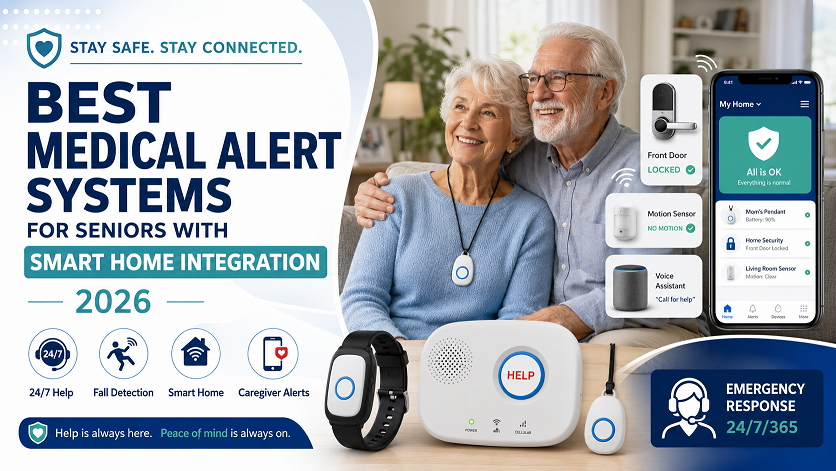
Best Medical Alert Systems for Seniors with Smart Home Integration 2026
The best medical alert systems for seniors with smart home integration in 2026 are Bay Alarm Medical (best overall — 8-second response times, Alexa-compatible, no contracts from $27.95/month), Medical Guardian (best for Alexa and Google Home combined, plus smartwatch option), MobileHelp (best value at $24.95/month with AT&T cellular), and ADT Medical Alert (best for Google Nest camera integration). Fall detection adds $10/month at all major providers and is strongly recommended for seniors living alone. All top systems work alongside smart home cameras as a complementary layer — cameras let families check in visually, while the medical alert pendant ensures emergency response even when no one is watching the camera feed.
The best medical alert systems for seniors with smart home integration do two things at once: they give a senior immediate access to emergency help through a wearable pendant, and they let family members check in remotely through cameras and caregiver apps. Each year, about 14 million older adults in the United States report falling, with over one million requiring hospitalization. A fall that goes undetected for hours leads to worse outcomes than one where help arrives in minutes.
In 2026, the gap between a standalone medical alert pendant and a smart-home-integrated senior safety setup has closed significantly. Today’s top medical alert systems connect to Amazon Alexa, Google Home, and caregiver apps — letting families see, hear, and check on loved ones without being physically present. This guide covers the five best medical alert systems for seniors that also integrate with the smart home devices already in their homes.
Why Smart Home Integration Matters for Medical Alert Systems
A traditional medical alert system works like this: the senior presses a button, a monitoring center answers, and dispatches emergency services. That model is proven and saves lives. But it has one significant limitation — it depends entirely on the senior pressing the button, which doesn’t always happen. Seniors often hesitate to call for help because they don’t want to be a burden, or they may be injured in a way that prevents them from reaching the button.
Smart home integration solves this in two ways. First, Alexa and Google Home voice commands provide an alternative activation path — saying “Alexa, call for help” is easier than reaching a pendant for some seniors. Second, paired smart home cameras give family members a proactive way to check in visually rather than waiting for an emergency to trigger the system.
Smart Home Cameras Complement — They Don’t Replace — Medical Alert Systems
A camera lets a family member check in visually when they’re worried. A medical alert pendant gets help automatically when no one is watching. Both serve different and important roles. The ideal senior safety setup in 2026 combines a wearable medical alert device with at least one smart home camera in the main living area — so family members can look in proactively, and the system can respond automatically if something goes wrong when no one is watching the camera feed.
Best Medical Alert Systems for Seniors with Smart Home Integration
- Fastest average response time in independent testing — 8 seconds
- Amazon Alexa compatible — works with Echo devices for voice check-ins
- Four device types: SOS Home, SOS Mobile, SOS Smartwatch, SOS All-In-One 2
- Waterproof devices — safe for shower and bathroom use
- No contracts — month-to-month billing
- 15-day risk-free trial
- Family-owned company — not private equity backed
- UL-certified monitoring centers
- Fall detection is an add-on at $10/month — not included in base price
- No Google Home integration — Alexa only
- No native caregiver app (uses Alexa Together for family check-ins)
- AT&T cellular coverage areas only for mobile device
- Integrates with both Amazon Alexa and Google Home — broadest smart home compatibility
- Six packages — most variety of any top provider
- MGMove smartwatch with GPS, step tracking, and fall detection
- Caregiver app (MyGuardian) with activity tracking and location sharing
- Excellent performance in independent testing (TechRadar top pick)
- A+ BBB rating with thousands of positive reviews
- Marketing tactics rated pushy in some independent tests
- Above-average pricing at higher plan tiers
- Contracts required on some equipment plans
- Fall detection add-on cost not always clearly displayed upfront
- $24.95/month — lowest starting price of any top-rated provider
- No contracts — month-to-month billing
- Amazon Alexa compatible
- In-home and mobile options with GPS
- MobileHelp Connect app for caregivers
- Landline or AT&T cellular base station options
- AT&T network only — not suitable for areas with poor AT&T coverage
- Google Home integration is limited compared to Medical Guardian
- Caregiver app less feature-rich than Medical Guardian’s MyGuardian
- Integrates with Google Nest cameras — most direct camera integration of any provider
- Works with both Alexa and Google Home
- ADT’s brand reputation and decades of monitoring experience
- Integrated fall detection available in the On-The-Go wearable device (no separate pendant)
- ADT+ app for system control
- Professional monitoring — fastest police dispatch infrastructure in the industry
- $99 activation fee — highest upfront cost on this list
- No companion caregiver app for family check-ins (unlike Medical Guardian)
- Higher starting price than MobileHelp or Bay Alarm Medical
- Some plans require a contract
- Phone-based — works as a smartphone (Jitterbug Smart4) or pendant alongside a phone
- Unique on-call nurse access — for medical questions, not just emergencies
- No separate device needed if using the Jitterbug smartphone
- Good for seniors resistant to wearing a pendant — the phone is the device
- GPS tracking via the phone
- Relies on the senior carrying and using a phone — less reliable than a wearable pendant
- Limited direct smart home integration compared to Bay Alarm or Medical Guardian
- Fall detection only available on specific device options
- Less suitable for seniors with significant mobility or cognitive limitations
Side-by-Side Comparison of Best Medical Alert Systems
| System | Starting Price | Alexa | Google Home | Fall Detection | Contract |
|---|---|---|---|---|---|
| Bay Alarm Medical | $27.95/mo | ✅ Yes | ❌ No | +$10/mo | No contract |
| Medical Guardian | $29.99/mo | ✅ Yes | ✅ Yes | +$10/mo | Some plans |
| MobileHelp | $24.95/mo | ✅ Yes | Limited | +$10/mo | No contract |
| ADT Medical Alert | $31.99/mo + $99 activation | ✅ Yes | ✅ Yes + Nest cameras | +$10/mo | Some plans |
| Lively | Varies by plan | Limited | ❌ No | Select devices | No contract |
Fall Detection: What It Is and Why It Costs $10 Extra
Fall detection is the feature that automatically calls for help when a sensor detects the motion pattern of a fall — without the senior having to press any button. Every major medical alert provider charges $10/month extra for fall detection, and it is consistently worth it for seniors who live alone or have a known fall risk.
The technology works through accelerometers in the wearable device that detect the characteristic motion pattern of a fall: rapid downward acceleration followed by an abrupt stop. When the device detects this pattern, it initiates an emergency call to the monitoring center automatically. The senior can speak to confirm or cancel; if there is no response, the monitoring center dispatches help.
Who Should Always Add Fall Detection
Fall detection is especially important for seniors who: live alone and could lie injured for hours before someone checks in; have a history of falls or balance issues; take medications that increase fall risk (blood pressure medications, sedatives); or have conditions like Parkinson’s or osteoporosis. At $10/month, fall detection is one of the most cost-effective safety investments available for at-risk seniors — and every top provider in this guide offers it as an add-on to any base plan.
Using Alexa Together Alongside a Medical Alert System
Amazon Alexa Together ($19.99/month) is a service specifically designed for senior care that works alongside — not instead of — a dedicated medical alert system. Together allows designated family members to:
- Drop in remotely on an Echo Show in the senior’s home to see and speak with them
- Receive activity alerts if the senior hasn’t been active in their home by a certain time
- Place urgent calls through the Alexa app to notify caregivers when the senior says “Alexa, call for help”
- Set up automated check-in reminders for medication, appointments, and daily routines
The key limitation: Alexa Together does not dispatch 911 or connect to a professional monitoring center. It contacts the family members you designate. For situations where the senior is injured and no one is immediately available on the family contact list, a dedicated medical alert system with professional monitoring remains essential. Bay Alarm Medical’s Alexa integration pairs particularly well with Alexa Together — the Bay Alarm pendant handles emergency response while the Echo Show handles family check-ins and daily communication.
How Smart Home Cameras Complement Medical Alert Systems
Smart home cameras and medical alert systems serve different and complementary roles in a senior safety setup. Understanding this distinction helps families build the most complete protection layer without overspending.
| Use Case | Smart Home Camera | Medical Alert System |
|---|---|---|
| Visual check-in on the senior | ✅ — family can view live feed anytime | ❌ — no video feed |
| Automatic fall detection | ⚠️ — some cameras (Nest, some Eufy models) detect motion; not all detect falls specifically | ✅ — wearable pendant detects fall pattern automatically |
| Emergency dispatch (police/fire/medical) | ❌ — camera alerts family but doesn’t dispatch services | ✅ — monitoring center dispatches emergency services |
| Protection outside the home | ❌ — home cameras only cover inside/outside the home | ✅ — mobile GPS device works anywhere with cell coverage |
| Two-way audio check-in | ✅ — Echo Show, Nest Hub allow two-way video/audio | ✅ — medical alert pendant has two-way audio with monitoring center |
The ideal setup for a senior living alone in 2026 combines a wearable medical alert pendant (Bay Alarm Medical or Medical Guardian) with at least one smart home camera in the main living area and an Echo Show or Nest Hub for voice-initiated check-ins. This three-layer approach covers: proactive family check-ins (camera), voice-activated help requests (Echo/Nest), and automatic emergency response (pendant with fall detection).
Does Medicare Cover Medical Alert Systems?
Original Medicare (Parts A and B) does not cover medical alert systems or personal emergency response devices. However, several alternative paths may reduce or eliminate the cost:
- Medicare Advantage (Part C): Some plans include medical alert systems as a supplemental benefit. Coverage, eligible devices, and qualifying conditions vary by plan and location — check your specific plan’s supplemental benefits section or call your plan’s member services line.
- Medicaid: Some state Medicaid waiver programs cover personal emergency response systems for qualifying seniors. Coverage and eligibility vary significantly by state.
- Veterans Benefits: The VA’s Home Modification program may cover medical alert devices for eligible veterans. Contact your local VA for current eligibility criteria.
- Area Agency on Aging: Many local Area Agencies on Aging offer subsidized or loaned medical alert devices for qualifying low-income seniors. Find your local agency at eldercare.acl.gov.
- No-contract monthly plans: If cost is the barrier, MobileHelp’s $24.95/month no-contract plan and Bay Alarm Medical’s 15-day risk-free trial provide the most accessible entry points without long-term financial commitment.
Conclusion: Choosing the Best Medical Alert System for Seniors with Smart Home Integration
The best medical alert systems for seniors with smart home integration in 2026 are no longer standalone pendant-and-button devices. They work alongside Alexa, Google Home, caregiver apps, and smart home cameras to build a layered safety network that gives seniors independence and families peace of mind.
For most families, Bay Alarm Medical is the right starting point — the fastest response times in the category, no contracts, Alexa integration, and a 15-day trial to confirm it works in the senior’s specific home environment. Families already committed to Google’s ecosystem should look at ADT Medical Alert for its direct Nest camera integration. Families on a fixed budget should start with MobileHelp at $24.95/month, confirming AT&T coverage first.
Regardless of which system you choose, add fall detection ($10/month) for any senior who lives alone or has a documented fall risk — it is the single highest-impact upgrade available at the lowest incremental cost. Pair the pendant with an Echo Show or Nest Hub for daily family check-ins, and the result is a senior safety setup that is genuinely more complete than anything that existed even two years ago.
Frequently Asked Questions
Which medical alert system integrates best with smart home cameras?
Medical Guardian offers the most complete smart home camera integration in 2026, with direct compatibility with Amazon Alexa and Google Home, plus a caregiver app that allows family members to check in remotely. Bay Alarm Medical integrates with Amazon Alexa through Alexa Together. ADT Medical Alert provides the most direct integration with Google Nest cameras specifically. For the tightest Amazon ecosystem integration, Bay Alarm Medical combined with an Echo Show camera and Alexa Together provides a seamless setup.
What is the best medical alert system with fall detection in 2026?
Bay Alarm Medical is the top-rated medical alert system with fall detection in 2026, earning PC Magazine’s Editors’ Choice award. Fall detection averages 8-second emergency response times and works across all four Bay Alarm device types. Fall detection adds $10 per month to any plan. Medical Guardian is the best option for seniors who want a smartwatch form factor with fall detection built in, along with both Alexa and Google Home compatibility.
How much does a medical alert system cost per month in 2026?
Medical alert system monthly costs in 2026 range from $24.95 (MobileHelp basic) to $59.99 (Aloe Care Health Essentials Plus). The most common price range for a capable system with professional monitoring is $29.95 to $44.95 per month. Fall detection adds $10/month at most providers. Most top providers including Bay Alarm Medical, MobileHelp, and Medical Guardian offer month-to-month billing with no long-term contracts.
Can Amazon Alexa be used as a medical alert system?
Alexa can supplement a medical alert system but should not replace one. Through Alexa Together ($19.99/month), family members can remotely drop in on a senior’s Echo Show, receive motion alerts, and be notified when a senior says “Alexa, call for help.” However, Alexa lacks automatic fall detection and does not dispatch 911 directly. A dedicated medical alert pendant with professional monitoring provides more reliable emergency response, especially outside the home or after a fall where the senior cannot speak.
Do medical alert systems work with Google Home?
Some medical alert systems work with Google Home. Medical Guardian supports both Alexa and Google Home. ADT Medical Alert integrates with Google Nest cameras and Google Home. MobileHelp works with Alexa but Google Home integration is limited. For the most complete Google Home integration, ADT Medical Alert combined with Google Nest cameras provides both professional monitoring and camera check-in capability through the Google Home app.
What is the difference between in-home and mobile medical alert systems?
In-home medical alert systems use a base station with a wearable button that works within 500–1,000 feet of the base — lower cost but no protection outside the home. Mobile systems use built-in GPS and cellular connectivity to work anywhere with cell coverage, at the grocery store, on a walk, or at a doctor’s appointment. Mobile systems cost more but provide complete protection for active seniors. Many providers offer hybrid plans with both an in-home base station and a mobile GPS device.
Does Medicare cover medical alert systems?
Original Medicare (Parts A and B) does not cover medical alert systems. Some Medicare Advantage plans (Part C) include them as a supplemental benefit — coverage varies by plan and location. Medicaid may cover costs through state waiver programs. Veterans may be eligible through VA home modification programs. Area Agencies on Aging offer subsidized devices for qualifying seniors. If cost is a barrier, MobileHelp at $24.95/month with no contract and Bay Alarm Medical’s 15-day risk-free trial are the most accessible entry points.
Related Guides
- Medical Daily — The 8 Best Medical Alert Systems for 2026 (April 2026)
- NCOA — Best Medical Alert Systems of 2026
- SeniorLiving.org — Best Medical Alert Systems Tested and Ranked 2026
- SeniorLiving.org — Best Medical Alert Systems with Fall Detection 2026
- SafeHome.org — Best Medical Alert Systems of 2026
- SafeHome.org — Best Medical Alert Systems with Fall Detection 2026
- TechRadar — Best Medical Alert System of 2026
- NCOA — Get the Facts on Falls Prevention
- Eldercare Locator — Find Local Area Agency on Aging