
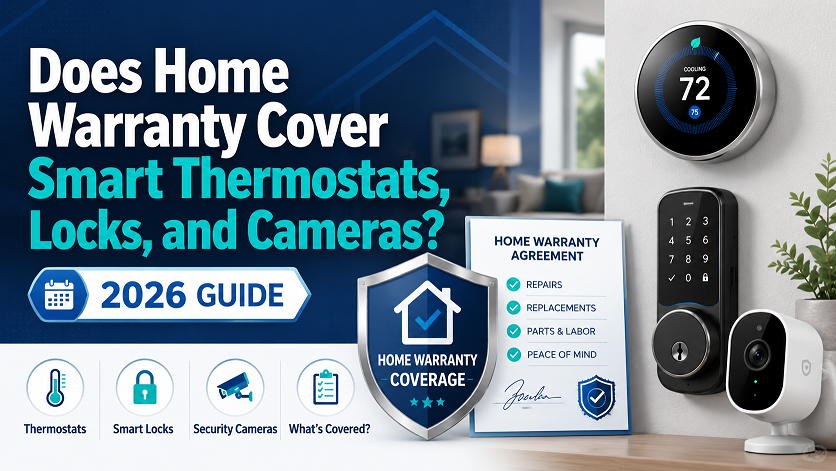
Does Home Warranty Cover Smart Thermostats, Locks, and Cameras? 2026 Guide
Standard home warranties partially cover smart thermostats but not smart locks, security cameras, or video doorbells. The key rule: home warranties cover mechanical and electrical components that affect core function — not the smart/Wi-Fi features themselves. A smart thermostat is covered if its heating valve fails; it’s not covered if it loses Wi-Fi or the app stops responding. Smart locks, cameras, and doorbells are electronics, not systems or appliances — they fall outside standard home warranty scope entirely unless you add an electronics protection plan (AHS offers one as an add-on; Home Warranty Inc. has a dedicated smart home plan). Annual home warranty costs range from $450–$700, with electronics add-ons typically adding $10–$15/month.
Home warranties have existed for decades to cover the expensive, unglamorous breakdowns that homeowners insurance doesn’t touch — the HVAC system that dies in July, the dishwasher that stops draining, the water heater that starts leaking at 11pm. They’re built around a model of covered “systems” and “appliances” failing from normal wear and tear.
Smart home devices fit awkwardly into this model. A Nest thermostat is both an HVAC component (which home warranties typically cover) and an internet-connected consumer electronic (which they typically don’t). A Ring doorbell is purely an electronic device — it doesn’t regulate temperature, pump water, or run a motor. A smart lock sits in yet another ambiguous space: it’s a door component, but the locking mechanism and the electronic smart features are separate things that can fail independently.
This guide explains exactly where the line falls for each device type — what’s covered, what isn’t, and how to fill the gaps that standard plans leave.
How Home Warranties Work (and Why Smart Features Are Different)
A home warranty covers the repair or replacement of home systems and appliances when they break down from normal wear and tear. The covered categories in a typical plan include: HVAC (heating, cooling), plumbing, electrical panels, kitchen appliances (refrigerator, oven, dishwasher), washer/dryer, and sometimes garage door openers.
The critical distinction for smart devices is the Old Republic Home Protection policy language that defines coverage for smart thermostats — and it applies broadly:
The Mechanical-vs-Smart Rule
If a smart device fails in a way that affects the core mechanical or electrical function it was designed to perform, a home warranty typically covers it. If the failure only relates to the smart/Wi-Fi/app features — but the device still performs its core function manually — a home warranty almost certainly does not cover it. A smart thermostat that can’t regulate temperature: covered. A smart thermostat that can’t connect to Wi-Fi but still adjusts temperature when you press the buttons: not covered. This rule applies across every major home warranty provider.
Coverage by Device Type
What’s covered: The thermostat’s heating valve, electrical connections, and any mechanical component that fails and prevents it from regulating temperature. If your Nest Thermostat fails in a way that causes your heating or cooling to stop working, a home warranty will typically replace it — and should replace it with a comparable smart thermostat (Old Republic explicitly states it will replace a smart thermostat with another smart thermostat).
What’s not covered: The Wi-Fi chip, the learning algorithms, the app connectivity, remote scheduling features, or any failure that leaves the thermostat still able to control temperature manually but unable to connect to your phone or Alexa. If you can still walk up to the thermostat and adjust the temperature, the warranty won’t cover the fact that the app doesn’t work.
What’s covered: Nothing under standard home warranty plans. Door locks are typically listed as exclusions in home warranty contracts — the mechanical locking mechanism is considered part of the home structure, and home warranties cover systems and appliances, not structural components. The electronic smart features are even further outside standard coverage.
The exception: AHS’s Electronics Protection Plan add-on specifically includes door locks. Home Warranty Inc.’s Smart Home Protection plan lists door locks as a covered item. If you have one of these add-on plans, a smart lock failure — mechanical or electronic — is typically covered.
What’s covered: Nothing under standard home warranty plans. Security cameras are consumer electronics, not home systems or appliances. Standard home warranties explicitly or implicitly exclude consumer electronics from coverage. A camera failing because its motor or wiring fails is not an HVAC, plumbing, or appliance issue — it falls entirely outside the coverage structure.
The exception: AHS Electronics Protection Plan add-on. Home Warranty Inc.’s Smart Home Protection plan lists security cameras as a covered item under their electronics plan, along with door locks, doorbells, thermostats, and hubs.
What’s covered: Wired doorbell wiring may be covered under some electrical system clauses — but the video doorbell device itself is electronics, not a covered system. The camera, Wi-Fi module, video processing, and app features are all outside standard home warranty scope.
A wired Ring or Nest doorbell that receives power from your home’s low-voltage wiring might have the wiring covered if the wiring fails, but the Ring device itself is not covered under that electrical coverage.
The Coverage Gap: What No Standard Plan Covers
Even beyond the device-by-device limitations, there’s a larger gap that affects all smart home devices — one that no standard home warranty, homeowners insurance policy, or manufacturer warranty addresses:
What Happens When a Manufacturer Stops Supporting a Device
In 2025, Neato shut down its cloud services — permanently disabling app control, scheduling, and mapping for every Wi-Fi-dependent Neato robot vacuum, regardless of how recently purchased. In 2020, Google discontinued the Nest Secure alarm system. No home warranty, homeowners insurance policy, or standard manufacturer warranty covered the loss of functionality — because none of those products protect against a company’s business decision to discontinue a product. If you’re building a smart home around any device that depends on a manufacturer’s cloud infrastructure, this is a real risk with no standard coverage solution. Choosing local-processing devices (Eufy’s local storage cameras, Z-Wave devices on your own hub) reduces but doesn’t eliminate this exposure.
How to Fill the Gap
For smart devices that fall outside standard home warranty coverage, these are the most practical options:
| Coverage Layer | What It Covers | What It Doesn’t Cover | Cost |
|---|---|---|---|
| Manufacturer warranty | Defects and failures not caused by user damage. Ecobee: 3 years. Most cameras/locks: 1 year. | Accidental damage, water damage, discontinued cloud support | Free (included with device) |
| Credit card extended warranty / purchase protection | Extends manufacturer warranty by 1 year (Chase Sapphire, Amex Gold, etc.). Some cards add accidental damage coverage. | Varies by card — check your specific benefits | Free (benefit of your card) |
| AHS Electronics Protection Plan | Electronics breakdown including smart home devices. Add-on to any AHS home warranty plan. | Physical damage, theft, items already covered by manufacturer warranty | ~$10–$15/month add-on |
| Home Warranty Inc. Smart Home Plan | Specifically covers doorbells, door locks, thermostats, security cameras, hubs/home controllers. Includes accidental damage. | Manufacturer warranty still active items, discontinued cloud services | Monthly fee — check current rates |
| Homeowners insurance | Theft, fire, storm damage, sudden accidental loss | Mechanical breakdown, wear and tear, manufacturer cloud shutdown | Covered under existing policy (subject to deductible) |
| Standalone electronics protection (Asurion, SquareTrade) | Device breakdown, accidental damage (drops, spills). Available per device or as a plan for multiple items. | Discontinued cloud support, theft in some plans | $3–$12/month per device or flat annual fee |
Provider Comparison — 2026
| Provider | Smart Thermostat | Smart Lock | Camera/Doorbell | Annual Cost Range |
|---|---|---|---|---|
| American Home Shield (AHS) | Partial — mechanical only | Electronics add-on only | Electronics add-on only | $29–$89/month + $10–15/mo add-on |
| Choice Home Warranty | Partial — mechanical only | Not covered | Not covered | ~$46–$55/month |
| Old Republic Home Protection | Partial — mechanical only (explicit policy language) | Not covered | Not covered | ~$50–$70/month |
| Home Warranty Inc. | Yes — including smart features | Yes — dedicated smart home plan | Yes — cameras, doorbells, hubs | Smart Home Plan — check current rates |
| Standard home warranty (typical) | Mechanical only | Excluded | Excluded | $450–$800/year ($65–$125 service fee) |
The Smartest Way to Protect Smart Devices Without Overpaying
Register every smart device with its manufacturer immediately after purchase — this preserves warranty rights and makes the claims process faster. For devices you’re most worried about (the $300 smart lock, the $250 Nest thermostat), check whether the credit card you purchased them on offers extended warranty or purchase protection — many premium cards extend manufacturer warranties by a year at no additional cost, which is often sufficient. Reserve dedicated electronics protection plans for high-ticket items that are outside manufacturer warranty and are genuinely irreplaceable at short notice. Don’t pay for protection on a $30 smart bulb or a $50 sensor — the economics don’t work.
Home Warranty vs. Homeowners Insurance for Smart Devices
The two products cover fundamentally different risks and are often confused. Here’s where each one applies for smart home devices:
| Scenario | Home Warranty | Homeowners Insurance |
|---|---|---|
| Smart thermostat mechanical failure from normal wear | ✅ Covered (mechanical component) | ❌ Not covered |
| Smart thermostat can’t connect to Wi-Fi | ❌ Not covered | ❌ Not covered |
| Security camera stolen in a burglary | ❌ Not covered | ✅ Covered (personal property theft) |
| Smart lock damaged in a break-in | ❌ Not covered | ✅ Covered (vandalism/forced entry) |
| Video doorbell damaged by lightning/power surge | ❌ Not typically covered | ⚠️ Possibly — check your policy’s surge/lightning coverage |
| Camera breaks down after 2 years of normal use | ❌ Not covered (electronics) | ❌ Not covered (wear and tear) |
| Manufacturer discontinues cloud support (Neato scenario) | ❌ Not covered | ❌ Not covered |
Want to Lower Your Insurance Premiums With Smart Devices?
Our homeowners insurance discount guide covers every device category — security systems, smoke detectors, water leak sensors — with real discount percentages by insurer.
Frequently Asked Questions
Does a home warranty cover smart thermostats?
Partially. Most home warranties cover thermostats as part of HVAC system coverage — but only the mechanical and electrical components that affect core heating and cooling function. Smart features (Wi-Fi connectivity, app control, remote scheduling, learning algorithms) are almost never covered. If your Nest or Ecobee fails because the heating valve breaks, a home warranty typically covers it. If it loses Wi-Fi connectivity but the thermostat still works manually, it almost certainly won’t. Old Republic Home Protection’s policy is explicit: a thermostat is covered if the malfunction affects its ability to regulate temperature; not if it only relates to the smart/Wi-Fi features while the thermostat still functions manually.
Does a home warranty cover smart locks?
Standard home warranties do not cover smart locks. Door locks are typically listed as excluded items — the mechanical locking mechanism is part of the home’s structure, and the electronic components are consumer electronics, neither of which fits the standard “systems and appliances” coverage model. American Home Shield’s Electronics Protection Plan add-on and Home Warranty Inc.’s dedicated smart home plan specifically cover door locks. If protecting your smart lock is a priority, an electronics protection plan or manufacturer extended warranty is the most direct path.
Does a home warranty cover security cameras or video doorbells?
Not under standard home warranty plans. Security cameras and video doorbells are consumer electronics — outside the “systems and appliances” framework of standard home warranties. American Home Shield’s Electronics Protection Plan and Home Warranty Inc.’s Smart Home Protection plan specifically include security cameras and doorbells as covered items. Manufacturer warranties (typically 1 year for Ring and Arlo, 1–2 years for Eufy) cover device defects. Homeowners insurance covers theft or sudden damage, not mechanical failure.
What is the difference between a home warranty and homeowners insurance for smart devices?
Homeowners insurance covers sudden accidental losses — a security camera stolen in a burglary, a smart thermostat damaged in a fire or storm. Home warranties cover gradual mechanical breakdown from normal wear and tear — a thermostat valve failing after years of use. Smart devices fall into a gap between both: manufacturers cover defects under warranty, homeowners insurance covers sudden losses, home warranties cover mechanical systems, and the “smart” component typically falls in the uncovered gap between all three — unless you purchase a specific electronics protection plan.
How much does a home warranty cost in 2026?
Standard home warranty plans typically cost $450–$700 per year. Premium plans can exceed $800/year. Service call fees (paid when a technician comes out) range from $65–$125 per visit. Electronics protection add-ons typically cost $10–$15 per month. American Home Shield’s plans range from ShieldSilver (systems only, lower cost) to ShieldPlatinum (systems, appliances, roof leak, HVAC tune-up), with the Electronics Protection Plan available as an add-on to any tier.
What actually covers my smart home devices if they break?
The most relevant protection layers are: (1) Manufacturer warranty — typically 1–3 years, covers defects and failures not caused by user damage. Ecobee: 3 years; Ring/Arlo: 1 year; Eufy: varies by model. (2) Credit card purchase protection — many cards extend manufacturer warranties by 1 year at no cost. Check your card benefits before buying dedicated plans. (3) Electronics protection plan add-on — AHS Electronics Protection, Home Warranty Inc.’s smart home plan, or standalone Asurion/SquareTrade. (4) Homeowners insurance — covers theft and sudden accidental loss only. One coverage gap none of these address: a device that stops working because the manufacturer discontinued cloud support — as happened with Neato in 2025.
Related Guides
- American Home Shield — Do Home Warranties Cover Smart Home Features? (December 2025)
- Old Republic Home Protection — Does My Home Warranty Cover Smart Devices?
- NerdWallet — Choice Home Warranty vs. American Home Shield 2026 (March 2026)
- Penny Pincher — What Does a Home Warranty Cover? Complete 2026 Guide
- Home Warranty Inc. — Electronics & Smart Home Coverage
- SureBright — Your Smart Security System Isn’t as Safe as You Think (June 2026)