
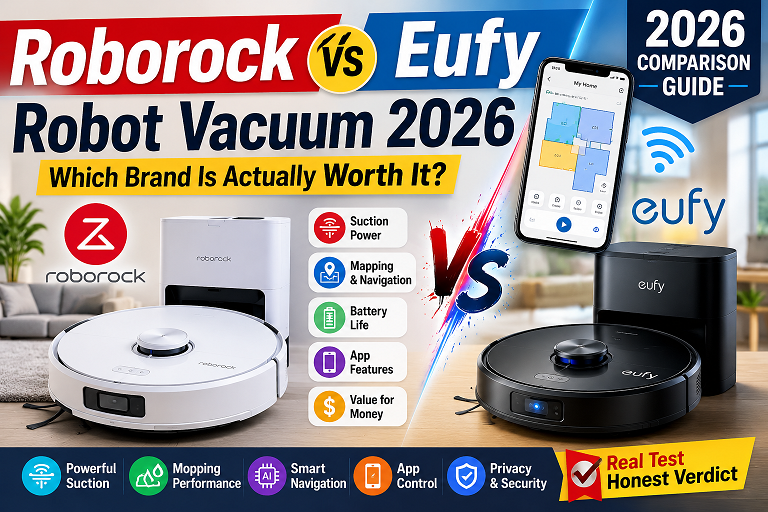
Roborock vs Eufy Robot Vacuum 2026: Which Brand Is Actually Worth It?
Roborock wins on carpet cleaning, LiDAR navigation, and overall value at the budget end. Eufy wins on mopping innovation and hard-floor deep cleaning. The Roborock Q7 M5+ (~$250) is the best value robot vacuum on the market right now — Wirecutter’s January 2026 Top Pick. The Eufy C28 Omni (~$500) beats every Roborock at the same price for wet messes and hard floors thanks to its HydroJet roller mop. At the flagship level, the Roborock Qrevo Curv ($1,600) is the carpet-cleaning king; the Eufy S1 Pro ($1,499) is the mopping champion. Which brand is “better” depends almost entirely on what’s underfoot in your home.
Roborock and Eufy are the two names that come up most reliably when someone asks “which robot vacuum should I actually buy?” They’ve earned that position for good reason — both produce genuinely capable machines, neither requires a brand subscription to get meaningful value, and both have built strong track records for software support over time. But they’ve taken very different roads to get here, and in 2026, those differences are more pronounced than ever.
Roborock started as a Xiaomi ecosystem partner and built its reputation on LiDAR navigation and carpet cleaning. Eufy positioned itself as the value-driven alternative with standout mopping — and its 2026 lineup has pushed that mopping advantage into territory where Roborock simply can’t follow without a significant product redesign.
This guide cuts through the spec sheets and looks at what these brands actually deliver in a real home — where they each win, which specific models to buy at each price point, and the real annual cost of running one of these machines once you factor in filters, bags, and brush replacement.
The Two Brands: What They Stand For
| Roborock | Eufy (by Anker) | |
|---|---|---|
| Founded / background | Beijing-based, former Xiaomi partner — now independent. Tech-first brand known for being first to market with LiDAR navigation in affordable models. | Subsidiary of Anker Innovations — positioned as the “value with quality” alternative to iRobot and Roborock. Carved a niche on clean-mopping innovation. |
| Core strength | Navigation accuracy, carpet deep-cleaning, app sophistication, best-in-class value at the budget tier | Mopping innovation (HydroJet roller mop), hard-floor performance, lineup breadth from $100 to $1,500 |
| Community sentiment (2026) | 1,789 positive Reddit mentions across 2,798 discussions — more than double any other brand | Strong positive reputation for value; occasional criticism at the premium tier for price-to-performance vs. Roborock |
| App quality | Roborock app widely considered polished and intuitive with granular room-by-room controls | eufy Clean app is capable and improving — simpler than Roborock’s but sufficient for most users |
| Price range | ~$200 (entry) to ~$1,600 (flagship) | ~$100 (entry) to ~$1,500 (flagship) |
Head-to-Head Across 6 Categories
Roborock consistently leads in LiDAR navigation accuracy and mapping reliability. Their ReactiveAI obstacle avoidance — using RGB camera and 3D structured light — is among the most precise in the industry, dynamically adjusting routes in real time. Multi-floor mapping, room-level scheduling, and no-go zone precision are all benchmarks Roborock helped define for the mid-range market.
Eufy uses LiDAR on its higher-end models and camera-based navigation on budget units. The mapping is solid for everyday use, but in independent tests Roborock models consistently produce cleaner, more reliable maps in complex layouts — homes with multiple rooms, tight corridors, or lots of furniture.
Roborock is the carpet-cleaning benchmark in 2026. The flagship Qrevo Curv achieved a 92% carpet deep-clean score — third overall in Vacuum Wars’ database regardless of price — with 0% hair tangles thanks to its DuoDivide dual-brush system. Their AdaptiLift chassis automatically raises the body when crossing from hard floors to carpet for improved suction contact.
Eufy’s flagship Omni S2 recorded the highest ever carpet vacuuming score in The Hook Up’s 2026 testing — but a side-facing exhaust design creates a leaf-blower effect with light debris, pushing fluff under furniture rather than picking it up. This is a meaningful real-world limitation that the raw score doesn’t capture. Eufy is strong on carpet; Roborock is more consistently reliable on it.
Eufy’s HydroJet roller mop system is the clearest competitive advantage the brand has in 2026. Unlike Roborock’s traditional spinning-pad mop (which essentially drags a damp cloth across the floor), the HydroJet continuously sprays fresh water onto a roller while collecting dirty water separately. The result: Eufy handles wet spills, dried-on residue, and stains significantly better than Roborock at equivalent price points.
The Eufy C28 Omni at $500 produced less residual water and stronger stain removal than any Roborock at the same price. The Eufy S1 Pro at $1,499 is currently considered the best roller mop in the consumer robot vacuum market. Roborock’s top-tier VibraRise mopping system (on the Qrevo Curv 2 Flow) is more capable than previous generations, but still trails Eufy on genuinely wet messes.
The Roborock Q7 M5+ at around $250 is widely considered the best-value all-in-one robot vacuum available in 2026 — Wirecutter’s January 2026 Top Pick. It delivers 10,000Pa suction, LiDAR navigation, dual anti-tangle brushes, mopping capability, and an auto-empty dock for less than Eufy’s cheapest comparable all-in-one. At this price point, Eufy simply doesn’t have a direct answer.
The Roborock app is consistently rated as one of the most polished and feature-rich in the robot vacuum category — room-by-room scheduling, invisible walls, no-go zones, multi-floor maps, cleaning history, and consumables tracking are all available. Alexa and Google Home integration is reliable across the range.
Eufy’s eufy Clean app is capable and has improved significantly, but remains somewhat simpler. This is a pro for less technical users and a con for anyone who wants granular control.
Roborock’s flagship DuoDivide dual-brush system records 0% hair tangles in testing on top-tier models. Eufy’s 2026 Omni S2 also completed testing completely tangle-free in The Hook Up’s evaluation. At the budget end, Roborock’s anti-tangle technology is more explicitly implemented across the range. Both brands are meaningfully better for pet hair than older generations from either company.
Best Models at Each Price Point (2026)
Rather than listing every model from both brands, here’s the practical pick at each tier — what to actually buy if your budget lands in that range.
Real Annual Cost of Ownership
The sticker price is only part of the story. Here’s what it actually costs to run a mid-range robot vacuum over 12 months, using the Roborock Q7 M5+ as a concrete example:
| Consumable | Replacement Frequency | Typical Annual Cost |
|---|---|---|
| Auto-empty dock bags | Every 4-8 weeks depending on dirt load (approx. 6-12 bags/year) | $20–$40 (packs of 3 run ~$12–$15) |
| HEPA filter | Every 2-3 months (4-6 per year) | $15–$25 |
| Main brush / brushroll | Every 6-12 months | $10–$20 |
| Side brushes | Every 3-6 months | $8–$15 |
| Mop pads (if applicable) | Every 1-3 months | $10–$20 |
| Electricity | Daily use | <$5/year |
| Total estimated annual running cost | — | $60–$100/year for a mid-range model running daily |
Bagless Stations Save Money — With a Trade-Off
Several 2026 models, including some Eufy flagships, use bagless auto-empty stations instead of disposable bags. This eliminates the bag cost entirely (saving $20-40/year) but requires you to periodically empty and clean the station’s dustbin by hand. If the thought of handling concentrated dust is a concern, stick with a bagged station. If you don’t mind the hands-on step, a bagless model can meaningfully reduce ongoing costs.
Who Should Buy Roborock vs Eufy?
🟡 Buy Roborock If…
- Your home is primarily carpet
- You have pets and want proven anti-tangle performance
- Your budget is under $300 (the Q7 M5+ is in a class of its own here)
- You want the most polished, granular app experience
- You have a complex multi-room layout that needs reliable mapping
- You’re replacing an older robot and want the biggest navigation upgrade
🔵 Buy Eufy If…
- Your home is mostly hard floors (tile, hardwood, LVP)
- Mopping quality matters as much as vacuuming — especially wet spills
- You want the best mid-range roller mop (C28 Omni at ~$500)
- You prefer a simpler app with less configuration overhead
- You’re in the $500+ bracket and mopping is your primary concern
- You want the absolute best roller mop available (S1 Pro at ~$1,499)
The One Scenario Where It’s Not Even Close
Under $300, with carpet, and you want an auto-empty dock: Roborock Q7 M5+, and it’s not a discussion. Eufy has nothing at this price that includes LiDAR navigation and an auto-empty dock together. The Q7 M5+ is genuinely one of those products where the value proposition is hard to argue against regardless of which brand you prefer.
Have Pets? See Our Dedicated Pet Hair Guide
We tested 5 robot vacuums specifically on real pet hair, including hair-tangle performance and brush maintenance time — across both brands.
Frequently Asked Questions
Is Roborock better than Eufy?
It depends on your floors. Roborock consistently leads in LiDAR navigation accuracy, carpet deep-cleaning performance, and app sophistication. The Roborock Q7 M5+ is widely considered the best value in robot vacuums at around $250 for 2026. Eufy leads in mopping innovation — particularly with its HydroJet roller mop system, which handles wet messes and stains better than Roborock’s spinning-pad alternatives — and often delivers better value at the budget end of the market. If your home is mostly carpet, Roborock. Mostly hard floors you want clean and mopped thoroughly, Eufy.
Which Roborock model is the best value in 2026?
The Roborock Q7 M5+ at around $250 is widely cited as the best value robot vacuum in 2026, named Wirecutter’s January 2026 Top Pick. You get 10,000Pa suction, LiDAR navigation, dual anti-tangle brushes, mopping, and an auto-empty dock at a price point where Eufy doesn’t have a competitive all-in-one model. For a mid-range step up, the Roborock Qrevo S at around $500 adds better navigation and carpet cleaning with a slightly smaller auto-empty station.
Which Eufy robot vacuum is best for hard floors in 2026?
The Eufy C28 Omni at around $500 stands out for hard floors in 2026 with 15,000Pa suction and the HydroJet continuous-clean roller mop that sprays fresh water onto the roller while collecting dirty water separately. This makes it unusually effective at wet spills and stains on hard floors without spreading dirty water around. For those who want the absolute best mopping performance at a premium, the Eufy S1 Pro ($1,499) carries the most advanced roller mop system Eufy makes.
Do robot vacuums actually replace regular vacuuming?
For maintenance cleaning between deep cleans, yes — most current robot vacuums with LiDAR navigation handle daily or every-other-day dust, hair, and debris pickup well enough that most households can reduce manual vacuuming significantly. Where robot vacuums typically still fall short: thick carpet deep-cleaning, corners and edges against walls, stairs, heavy debris concentrations, and anywhere the robot can’t physically reach. The practical expectation for most users in 2026 is that a robot vacuum handles 70-80% of floor maintenance automatically, while occasional manual vacuuming covers the rest.
How much does a robot vacuum cost to run annually?
Beyond the upfront cost, the main recurring expenses are filter replacement, brush replacement, and auto-empty dock bags if applicable. A typical mid-range robot vacuum running daily costs roughly $60-100/year in consumables. Auto-empty bags for the Roborock Q7 M5+ run about $15 for a pack of three. Bagless base stations eliminate the bag cost but add a periodic hands-on dustbin cleaning step. Electricity consumption is minimal — most models use less than $5/year even running daily.
Is Roborock or Eufy better for pet hair?
Roborock’s dual anti-tangle DuoDivide brushes on flagship models are specifically designed to minimize hair tangles — the Qrevo Curv series recorded 0% hair tangles in independent testing. Eufy has made progress on hair tangle avoidance in 2026 models, with the Omni S2 completing testing completely tangle-free despite handling significant amounts of hair. At the value end, Roborock’s Q7 M5+ handles pet hair well for the price. For most pet households, both brands have capable options — but Roborock’s flagship anti-tangle technology is more explicitly documented across its range.