
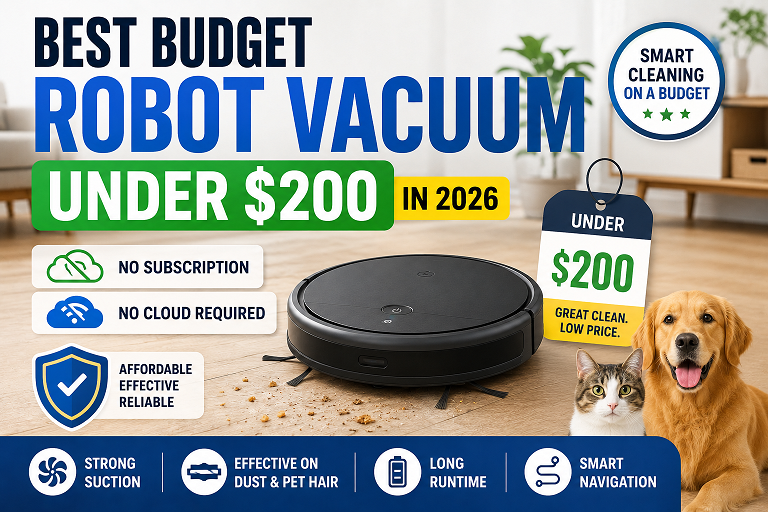
Best Budget Robot Vacuum Under $200 in 2026 — No Subscription, No Cloud Required
No robot vacuum under $200 requires a subscription in 2026 — scheduling, app control, and cleaning history are included at the purchase price across all major brands. The standout pick is the Ecovacs Deebot N10 Plus — the only under-$200 model with LiDAR navigation, giving it systematic room-by-room cleaning that random-path competitors can’t match. For buyers who want zero cloud or app dependency, the Eufy RoboVac 11S MAX works entirely offline, scheduled via IR remote with no account required. For a mop combo on hard floors, the iRobot Roomba Combo Essential adds a built-in wet pad. One important note: Neato’s cloud shutdown in 2025 wiped out scheduling and maps for thousands of owners overnight — this guide avoids models where core features could be similarly lost.
About 40% of first-time robot vacuum buyers want to test the concept before committing to a $1,000 machine — a completely reasonable approach. The under-$200 tier in 2026 is genuinely capable for light-to-moderate use, and unlike the subscription-gated world of smart cameras and video doorbells, robot vacuums don’t lock core features behind monthly fees.
What changed heading into 2026 is the cloud dependency question. Neato’s full cloud shutdown last year — which permanently removed app control, scheduling, and mapping from thousands of working robots overnight — made “what happens to my vacuum if the company stops supporting it?” a real question rather than a hypothetical. This guide prioritizes models with strong long-term software track records and, for buyers who want complete independence, fully offline options that have no cloud to shut down.
Why “No Cloud Dependency” Matters More Now
What Happened to Neato Owners
In 2025, Neato shut down its cloud services entirely. Every owner of a Wi-Fi-dependent Neato robot vacuum — regardless of how recently they bought it or how much they paid — permanently lost access to app scheduling, room maps, and no-go zones. The robots still turned on and cleaned in a basic manual mode, but everything that made them “smart” was gone with no warning and no refund. This isn’t a hypothetical risk. It happened, it affected thousands of people, and it’s why “what does this vacuum do if the app disappears?” is now a legitimate purchase question — particularly at budget price points where brands have thinner margins and longer-term software support is less certain.
The practical implication for buyers: prioritize brands with a clear track record of long-term software support (Eufy/Anker, Ecovacs, Shark, iRobot) over newer or lesser-known brands whose cloud infrastructure is a single funding round away from disappearing. And if cloud dependency concerns you entirely, the fully offline picks later in this guide are worth a look — they cost less, set up in under five minutes, and have literally nothing to shut down.
What to Realistically Expect Under $200
| Feature | Under $200 Reality | Mid-Range ($250–$500) Comparison |
|---|---|---|
| Navigation type | Random-path or gyroscopic on most models — covers 70-80% per run; the Ecovacs N10 Plus is the exception with LiDAR | LiDAR standard — 90-95% floor coverage per run, room scheduling, no-go zones |
| Suction power | 1,500–3,000 Pa typical — adequate for hard floors and low-pile carpet | 8,000–15,000 Pa — meaningfully better on medium and thick carpet |
| Self-emptying dock | Rare — most require manual bin emptying after each run | Standard on most mid-range models |
| Subscription required | No — none of the recommended models require one | No — robot vacuums don’t gate features behind subscriptions |
| App/voice control | Yes — Alexa and Google Home on all Wi-Fi models | Yes — same or more advanced |
| Obstacle avoidance | Basic bump sensors on most — the Eufy G30 Edge adds object detection | Camera-based or 3D structured light on mid-range+ |
The Honest Case for Budget
Under $200, you’re getting a machine that will reliably clean daily and require manual emptying after most runs. If your home is primarily hard floors and under 1,000 sq ft — and you’re willing to empty the dustbin every day or two — a budget robot vacuum delivers real time savings at a low entry cost. If you have carpet throughout, multiple levels, or you want the robot to genuinely run unattended for weeks, save another $50 for the Roborock Q7 M5+ and get a categorically different machine.
Top 5 Budget Robot Vacuums Under $200 (2026)
- Only sub-$200 model with LiDAR navigation — systematic row cleaning vs. random bounce
- Auto-empty dock included — rare at this price point
- Room-level scheduling and no-go zones via the app
- No subscription required — all features included at purchase
- 90-95% floor coverage per run (vs. 70-80% on random-path models)
- 3,000 Pa suction — adequate for hard floors, struggles with thick carpet
- Basic obstacle avoidance — bump sensors rather than camera-based
- Ecovacs app is capable but less polished than Roborock’s
- Object detection — avoids furniture better than bump-only sensors
- Dedicated edge brushes for baseboards and corners
- Eufy’s near-top reliability score in Consumer Reports member surveys
- Full app scheduling, Alexa/Google Home — no subscription
- Eufy has strong long-term app support track record
- Gyroscopic navigation — random-path, not systematic row cleaning
- No auto-empty dock — manual bin emptying required
- 2,000 Pa is limited on carpet
- Vacuum and wet mopping in one machine under $200
- $179 — the most affordable mop-combo robot vacuum available
- Full scheduling and app control with no subscription required
- iRobot membership is entirely optional — not required for core features
- Alexa and Google Home integration
- iRobot’s ownership situation is in flux — see note below
- Wet pad mopping is basic — drags a damp cloth, not a roller mop
- Random-path navigation — no LiDAR, no systematic rows
- No auto-empty dock
- Shark’s established brand reputation and customer support network
- Full app scheduling, Alexa/Google Home — no subscription
- Widely available and well-reviewed at this price tier
- Shark has a strong track record of long-term app support
- Random-path navigation — not systematic room-by-room cleaning
- No auto-empty dock at this price
- Less standout in performance data vs. Eufy G30 or Ecovacs N10 Plus
- Ultra-compact design fits under low furniture other robots can’t reach
- Full scheduling and app control without subscription
- Good for studio apartments, dorms, small offices
- Alexa and Google Home compatible
- Smaller dustbin — more frequent emptying than larger models
- Limited suction for carpet
- Lefant is a less established brand than the others in this guide
Fully Offline Picks — Zero Wi-Fi Required
For buyers who don’t want any connected device — no app account, no Wi-Fi password shared with the vacuum, no cloud dependency — fully offline robot vacuums are a real and practical option. They schedule via IR remote and clean on a timer, with nothing to shut down or hack.
Side-by-Side Comparison
| Model | Navigation | Subscription | Auto-Empty | Best For |
|---|---|---|---|---|
| Ecovacs Deebot N10 Plus | LiDAR | None | Yes — included | Best overall — systematic cleaning + auto-empty under $200 |
| Eufy RoboVac G30 Edge | Gyroscopic | None | No | Best alternative — reliable brand, object detection |
| iRobot Roomba Combo Essential | Random-path | None (optional membership) | No | Best vacuum + mop combo under $200 |
| Shark RV2502AE | Random-path | None | No | Best for brand-trust buyers |
| Lefant M210P | Random-path | None | No | Best for furniture-dense tight spaces |
| Eufy RoboVac 11S MAX | Random-path | None — fully offline | No | Best for zero cloud dependency |
When to Skip This Tier and Spend $250 Instead
This tier is the right choice for many buyers — but not all. Here’s when the extra $50 for the Roborock Q7 M5+ makes a meaningful difference:
- You have pets. The Q7 M5+’s dual anti-tangle brushes and auto-empty dock are categorically better for pet hair. An under-$200 model will require more frequent brush cleaning and daily bin emptying.
- You have carpet throughout. 10,000 Pa vs. 2,000-3,000 Pa is a real difference on carpet. Budget models handle low-pile carpet acceptably; medium to thick carpet is where they struggle.
- You have a large or multi-room home. LiDAR navigation at the Q7 M5+’s level gives you room-by-room scheduling, no-go zones, and reliable full-home mapping. The Deebot N10 Plus has LiDAR but at lower suction — for a large home with carpet, the Q7 M5+ is a better investment.
- You don’t want to empty a bin daily. Auto-empty docks at the budget tier are rare. The Q7 M5+ includes one at $250; under $200, only the Deebot N10 Plus matches it.
The Right Budget Model IS the Right Starter
Not every buyer needs $250 worth of robot vacuum. If you’re in a studio apartment with hardwood floors and one small pet, the Eufy G30 Edge does the job reliably for significantly less. The point isn’t to upsell — it’s to make sure the model you buy actually matches your home’s floor type, size, and pet situation, rather than buying budget and being frustrated by limitations that a modest extra spend would have solved.
Have Pets and a Bigger Budget?
Our pet hair guide covers 5 models tested specifically on real dog and cat fur — including the best tangle-free options across every price tier.
Frequently Asked Questions
Do any robot vacuums under $200 actually work well?
Yes — with realistic expectations. At under $200 in 2026, the best models handle hard floors and low-to-medium pile carpet reliably, run on schedules without a subscription, and require minimal maintenance. What they trade away: LiDAR navigation on most models (the Ecovacs N10 Plus is the exception), self-emptying docks, and deep-carpet suction above 3,000 Pa. For a first-time buyer, a small apartment, or light-use homes, under-$200 models deliver genuine value.
Do robot vacuums under $200 require a subscription?
No. In 2026, robot vacuums do not gate core cleaning features behind subscriptions. All five models covered in this guide include full scheduling, voice control, app access, and cleaning history at the purchase price with zero monthly fees. iRobot offers an optional paid membership for extended warranty and parts coverage, but it is entirely optional — the robot vacuum works fully without it.
What happened to Neato robot vacuums?
In 2025, Neato shut down its cloud services entirely — permanently removing scheduling, mapping, and app access for every Wi-Fi-dependent Neato robot vacuum still in use. Owners were left with vacuums that only ran in manual mode by pressing the physical button. This is a concrete example of what can happen when a robot vacuum’s features depend on a manufacturer’s cloud infrastructure, and it’s one reason this guide prioritizes brands with strong long-term software support track records.
What is the difference between random-path and LiDAR navigation in budget robot vacuums?
Random-path navigation means the robot moves in semi-random patterns until its battery runs out, covering roughly 70-80% of the floor area per run without a map of your home. LiDAR navigation uses a spinning laser to build a precise map and clean in systematic rows, covering 90-95% of the floor per run and allowing room-level scheduling and no-go zones. The Ecovacs Deebot N10 Plus is the rare under-$200 model that includes LiDAR — most others in this price range use random or gyroscopic navigation.
Is the Eufy RoboVac 11S MAX a good offline robot vacuum?
Yes, for buyers who want zero cloud dependency. The 11S MAX works fully without Wi-Fi — scheduled via IR remote with no account creation or app download required. It has a 2,000 Pa suction, a 2.85-inch ultra-slim profile for cleaning under low furniture, and runs up to 100 minutes per charge on hard floors. It uses random-path cleaning and won’t map your home, but for a simple apartment or a buyer who explicitly doesn’t want any connected smart home device, it’s one of the most reliable fully-offline options available.
Should I buy a budget robot vacuum or save up for a mid-range one?
If you have mostly hard floors, a small-to-medium home, and want daily maintenance without deep cleaning expectations — under $200 delivers real value. If you have lots of carpet, pets, a large home, or want reliable full-coverage navigation — the Roborock Q7 M5+ at around $250 is worth the extra spend. It includes LiDAR, an auto-empty dock, and dual anti-tangle brushes that no under-$200 model matches. If $200 is your hard limit, buy the Ecovacs Deebot N10 Plus. If you can stretch to $250, the Q7 M5+ is a meaningfully better machine.
Related Guides
- Vacuum Wars — Best Robot Vacuum Under $300 June 2026
- RTINGS — Best Budget Robot Vacuums of 2026
- Tom’s Guide — Best Cheap Robot Vacuums 2026
- Smart Home Explorer — Best Robot Vacuums Under $200 2026
- Everyday Home Comfort — Best Robot Vacuum Without Internet 2026
- Engadget — Best Budget Robot Vacuums for 2026