
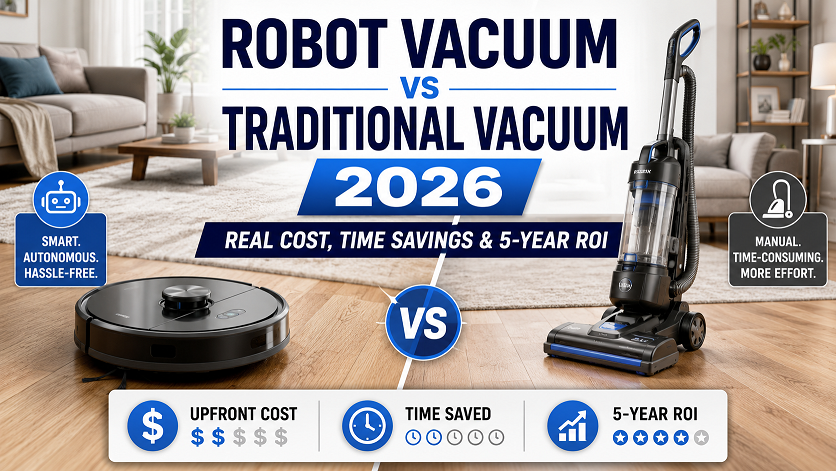
Robot Vacuum vs Traditional Vacuum 2026: Real Cost, Time Savings & 5-Year ROI
A mid-range robot vacuum saves 2–4 hours of cleaning per week and pays for itself in 7–15 weeks when you value your time at $20/hour. Over 5 years, every robot vacuum in independent cost modeling generates a positive return on investment when time is valued at that rate — the Roborock Q Revo produces the best 5-year TCO at -$1,861 net. Robot vacuums cost $269–$1,134 more in raw dollars over 5 years than a traditional vacuum, but those numbers flip to positive once time savings are factored in. The clearest case for a robot vacuum: pet owners, hard-floor households, and anyone who currently vacuums more than twice a week. The weakest case: a once-a-week vacuumer with mostly thick carpet in a small home.
The “is a robot vacuum worth it?” question comes up every time someone looks at a $500 price tag and asks whether they could just use those 20 minutes a day to vacuum manually. The honest answer depends almost entirely on two things: how you value your time, and what your floors actually look like.
This guide skips the marketing numbers and runs the real math — upfront cost, annual consumables, energy use, and most importantly, the weekly time savings that the sticker price doesn’t capture. All cost figures are based on published 5-year total cost of ownership modeling using verified March 2026 pricing from Amazon and manufacturer sites, cross-referenced against Wirecutter, RTINGS, Consumer Reports, and Vacuum Wars testing data.
Upfront Cost Comparison
The sticker price difference is the most visible part of the comparison — and it’s real. But it’s also the least informative number for deciding whether a robot vacuum is worth it, because it ignores time and running costs entirely.
| Type | Price Range | Typical Models |
|---|---|---|
| Budget robot vacuum | $150–$200 | Eufy RoboVac G30 Edge, Ecovacs Deebot N10 Plus |
| Mid-range robot vacuum | $250–$500 | Roborock Q7 M5+, Eufy C28 Omni, Roborock Qrevo S |
| Premium robot vacuum | $600–$1,600 | Roborock Saros 20, Dreame L40 Ultra, Eufy S1 Pro |
| Budget traditional vacuum | $50–$150 | Bissell CleanView, Shark Navigator Lift-Away |
| Mid-range traditional vacuum | $150–$350 | Dyson V8, Shark Stratos, Miele Classic C1 |
| Premium traditional vacuum | $400–$900 | Dyson V15 Detect, Miele Complete C3 |
The Right Comparison Isn’t Budget Robot vs Budget Traditional
Most people comparing robot vacuums to traditional vacuums mentally compare the $250 robot to the $80 Bissell they already own — which makes the robot look expensive. The fairer comparison is: what would you spend on a traditional vacuum that actually does what you need? If you have pets and carpet, a $200+ traditional vacuum is more realistic than an $80 entry-level model. The gap narrows significantly when you compare the Roborock Q7 M5+ at $250 to a capable Shark or Dyson stick vacuum at $180-250.
Annual Running Costs: Parts, Energy, and Maintenance Time
| Cost Item | Robot Vacuum (Mid-Range) | Traditional Vacuum (Mid-Range) |
|---|---|---|
| Filters | $15–$25/year (replace every 2–3 months) | $10–$20/year (HEPA filters every 6–12 months) |
| Bags/dustbin | Auto-empty dock bags: $20–$40/year (bagless: $0 + cleaning time) | Bags (bagged models): $15–$30/year; bagless: $0 |
| Brush rolls | $10–$20/year (replace annually) | $10–$25/year (replace every 12–18 months) |
| Side brushes | $8–$15/year | N/A |
| Electricity | ~$3–$5/year (daily use, 20–40W) | ~$4–$8/year (weekly use, 1,000–1,400W) |
| Total annual cost | $56–$105/year | $39–$83/year |
The annual running cost difference is modest — roughly $20–$40/year more for the robot vacuum. Over 5 years that’s $100–$200 in extra consumable spend, which is the smallest line item in the full comparison once time is factored in.
How Much Time Does a Robot Vacuum Actually Save?
This is the number that determines whether a robot vacuum makes financial sense — and it’s also the one most often left out of the comparison. Independent analysis puts the realistic time savings at 2–4 hours per week for a typical household running a robot vacuum daily.
Note: Time savings are net of robot maintenance (bin emptying, brush cleaning, clearing jams) — estimated at 15–30 min/week for a non-auto-empty model, ~5 min/week for an auto-empty model running reliably. Source: SmartHomeExplorer TCO analysis, March 2026; HomeVacuumZone ROI analysis, February 2026.
5-Year Total Cost of Ownership
The most complete way to compare the two is a 5-year total cost of ownership (TCO) model that combines upfront price, 5 years of consumables, 5 years of energy, and the economic value of time saved. This methodology was developed by SmartHomeExplorer using a $20/hour time value — a conservative figure for most US households.
| Scenario | 5-Year Raw Cost (No Time) | Time Value Saved (5 yrs) | Net 5-Year TCO |
|---|---|---|---|
| Roborock Q7 M5+ (~$250) vs. $150 traditional vacuum | Robot costs ~$350 more over 5 years | 2 hrs/wk × $20 × 260 wks = $10,400 | ~-$10,050 net (robot wins by a wide margin) |
| Roborock Qrevo S (~$500) vs. $200 traditional vacuum | Robot costs ~$600 more over 5 years | 2.5 hrs/wk × $20 × 260 wks = $13,000 | ~-$12,400 net |
| Budget robot (~$180) vs. $80 traditional vacuum | Robot costs ~$300 more over 5 years | 1.5 hrs/wk × $20 × 260 wks = $7,800 | ~-$7,500 net |
| Low-use household (vacuums 1x/week already) | Robot costs ~$350 more over 5 years | 0.5 hrs/wk × $20 × 260 wks = $2,600 | ~-$2,250 net (robot still wins, but by less) |
The Time Value Assumption Is the Most Important Variable
Every ROI calculation for robot vacuums hinges on how much you value your time. At $20/hour — a deliberately conservative figure for US households — every model generates a positive return. If you value your time at $10/hour (below US federal minimum wage), the math is closer. If you value it at $30-50/hour — closer to the actual hourly rate of most working professionals — the robot vacuum case becomes overwhelming. The honest question to ask yourself: what would you pay someone else to do this cleaning for you? That’s roughly your actual time value, and it’s usually higher than $20/hour for most people reading this.
Payback Calculator: When Does It Pay for Itself?
Forget the 5-year model for a moment — here’s the simple payback calculation for the most common scenario: buying a $250 Roborock Q7 M5+ to replace or supplement a $150 traditional vacuum (a $100 net upgrade cost), assuming 2 hours of weekly time savings.
| Your Time Value | Weekly Time Saved | Weeks to Payback ($100 net upgrade) |
|---|---|---|
| $10/hour | 2 hours/week | 5 weeks |
| $15/hour | 2 hours/week | 3.3 weeks |
| $20/hour | 2 hours/week | 2.5 weeks |
| $10/hour | 1 hour/week (low-use household) | 10 weeks |
| $20/hour | 3 hours/week (pet household) | 1.7 weeks |
The Payback Is Faster Than Most People Expect
The number most people are surprised by is that even at a conservative time value, payback on a mid-range robot vacuum happens in weeks, not months or years. The mistake most people make is comparing the $250 purchase price to zero — when in reality the comparison is the $250 robot against the continued cost of their time spent manually vacuuming. Framed that way, the math almost always favors the robot for anyone who vacuums more than once a week.
Robot Vacuum vs Traditional Vacuum: Who Wins for Your Home?
🤖 Buy a Robot Vacuum If…
- You have pets — daily hair maintenance is the robot’s strongest use case
- Your home is mostly hard floors or low-pile carpet
- You currently vacuum more than twice a week
- You value your time above $10/hour
- You travel frequently and want floors maintained in your absence
- You have allergies — daily cleaning reduces accumulated dander significantly
- Your home is single-level with relatively open floor plans
🧹 Stick With Traditional Vacuum If…
- Your home is mostly thick plush or shag carpet
- You only vacuum once a week — the time savings are minimal
- Your home is multi-story with lots of stairs to cover
- You have a very cluttered floor layout that confuses robots frequently
- You already own a high-quality traditional vacuum with years of life left
- Budget is truly tight and you can’t stretch to even $150-200
What Traditional Vacuum to Keep Alongside a Robot
Most robot vacuum owners don’t throw out their traditional vacuum — they just use it much less often. The practical model that works best for most households:
- Robot vacuum runs daily — handles surface maintenance, dust, pet hair, crumbs.
- Traditional vacuum used once every 1–2 weeks — deep carpet extraction, stairs, upholstery, edges the robot misses.
For the manual role, you don’t need a full-size upright anymore — a lightweight stick vacuum handles the remaining jobs well enough. The Shark Vertex or Dyson V8 (both in the $150–$250 range) work well as the “spot and stairs” complement to a robot vacuum. If you already own a full-size upright you’re happy with, there’s no reason to replace it — just use it less frequently and let the robot handle the daily load.
Ready to Pick a Robot Vacuum?
Our full Roborock vs. Eufy brand comparison covers every price tier — including the $250 Q7 M5+ that our ROI model consistently identifies as the strongest value pick.
Frequently Asked Questions
Is a robot vacuum worth the money in 2026?
For most households, yes — when you account for time savings. At a conservative $20/hour value of time, a mid-range $500 robot vacuum that saves 2 hours of cleaning per week pays for itself in about 13 weeks. Even the $250 Roborock Q7 M5+ reaches ROI-positive in under 7 weeks at that time value. The math is less favorable if you already own a perfectly good traditional vacuum, have mostly thick carpet the robot struggles with, or only vacuum once a week. Robot vacuums are most clearly worth it for daily maintainers, pet owners, hard-floor households, and busy professionals who genuinely value time above $15/hour.
Does a robot vacuum replace a traditional vacuum entirely?
Not entirely — but it significantly reduces how often you need one. Robot vacuums handle daily maintenance cleaning well: dust, pet hair, light debris, and surface-level dirt on hard floors and low-pile carpet. Where a traditional vacuum still does a better job: deep carpet extraction (especially plush and shag), stairs, upholstery, under cushions, and any space the robot can’t physically reach. The practical model for most pet households is a robot vacuum running daily plus a traditional vacuum used once every 1-2 weeks for deep cleaning and spaces the robot misses.
How much does it cost to run a robot vacuum per year?
Electricity is minimal — most robot vacuums cost under $5 per year even running daily. The main annual costs are consumables: filter replacement ($15-25/year), brush roll replacement ($10-20/year), side brushes ($8-15/year), and auto-empty dock bags if applicable ($20-40/year). Total annual running cost for a mid-range robot vacuum with an auto-empty dock is roughly $60-100/year — modestly more than a traditional vacuum’s $40-80/year, but the gap is small relative to the time savings.
How many hours per week does a robot vacuum actually save?
Independent analysis puts the realistic time savings at 2-4 hours per week for a typical household running a robot vacuum daily. The lower end applies to smaller homes or households that already vacuumed less frequently. The higher end applies to larger homes, pet households, or households that previously vacuumed daily or every other day. You still spend some time on maintenance — emptying the bin, cleaning brushes — which adds roughly 15-30 minutes per week on a non-auto-empty model, and under 5 minutes per week on an auto-empty model running reliably.
Do robot vacuums use a lot of electricity?
No. A typical robot vacuum uses 20-40 watts during operation. Running daily for 60-90 minutes, it costs roughly $2-5 per year in electricity at average US residential rates. A traditional upright vacuum uses 1,000-1,400 watts during operation — but runs only 1-2 hours per week, so its annual electricity cost is similarly modest at $4-8/year. Energy cost is not a meaningful differentiator between the two in a typical US household.
What traditional vacuum should I keep alongside a robot vacuum?
A lightweight stick vacuum or a mid-range canister works well as the manual complement to a robot vacuum, since you’re using it for targeted deep cleaning and spot work rather than full-floor runs. Shark, Dyson, and Bissell all make capable stick vacuums in the $100-200 range that handle stairs, upholstery, and the occasional deep-carpet session. If you already own a full-size upright you like, there’s no need to replace it — just use it less often and let the robot handle daily maintenance.
Related Guides
- SmartHomeExplorer — Robot Vacuum vs Traditional Vacuum: 5-Year Cost Comparison (March 2026)
- HomeVacuumZone — Are Robot Vacuums Worth It? 2026 ROI Analysis (February 2026)
- Vacuum Wars — Top 20 Best Robot Vacuums June 2026
- PC Tech Magazine — How Robot Vacuums Compare on Cost Versus Time Saved (May 2026)